
You’ve probably done this already. You paid for a decent website, added your headshot, your listings, a contact form, maybe even a home search tool, and then waited for leads that never really came.
That’s the normal real estate website problem. It looks professional, but it asks visitors to figure out what to do next. Most won’t. Buyers are distracted, sellers are skeptical, and everyone is moving fast. If your page doesn’t give them one clear next step, they leave.
A real estate landing page fixes that. It isn’t your whole website. It’s a focused page built around one offer, one audience, and one action. Done right, it turns your marketing from “hoping people reach out” into a repeatable lead capture system. That matters even more if you’re a busy agent who doesn’t have time to build custom campaigns from scratch every week.
Table of Contents
- Why Your Website Isn't Generating Leads (And What to Do)
- Laying the Foundation for a High-Converting Page
- Crafting Compelling Copy That Converts Visitors
- Designing a Clean and Trustworthy Page Layout
- Launching and Promoting Your New Landing Page
- How to Measure, Test, and Optimize for More Leads
- Turn Your Landing Page into a Marketing System
Why Your Website Isn't Generating Leads (And What to Do)
Your website isn’t broken. It’s just doing the wrong job.
A standard real estate website has too many paths. Visitors can browse listings, read your bio, click neighborhood pages, check your blog, and wander off without ever raising their hand. That’s fine for brand presence. It’s bad for lead generation.
A real estate landing page does the opposite. It narrows attention. One audience lands there. One offer is presented. One call to action gets the click. That’s why landing pages consistently outperform generic site forms.
According to a 2025 analysis, the average landing page conversion rate is 6.6%, while standard website signup forms average 0.6%, which means landing pages deliver more than 10x improvement in lead capture potential according to these landing page statistics from Sellerscommerce.
That gap isn’t small. It’s the difference between “I got some traffic” and “I generated actual conversations.”
Stop sending paid traffic, social traffic, or email clicks to your homepage. Send them to a page built for the exact offer they clicked on.
Here’s the practical shift I recommend:
- For sellers: create a page for a home valuation, market update, downsizing guide, or neighborhood price trend report.
- For buyers: create a page for a first-time buyer checklist, new listings alert, relocation guide, or neighborhood buying guide.
- For listings: create a page focused on one property, one audience, and one inquiry action.
Your website can still be your digital storefront. Keep it. But don’t expect it to do the conversion work of a dedicated campaign page.
If you want more leads, stop asking your homepage to behave like a sales page. Build a landing page for each campaign and give every click a clear destination.
Laying the Foundation for a High-Converting Page
The strongest landing pages aren’t built in Canva first or WordPress first. They’re built in strategy first.
Most agents skip this part because they’re busy. They jump straight to headline ideas, photos, and button colors. Then they wonder why the page feels flat. It feels flat because the offer isn’t sharp enough.
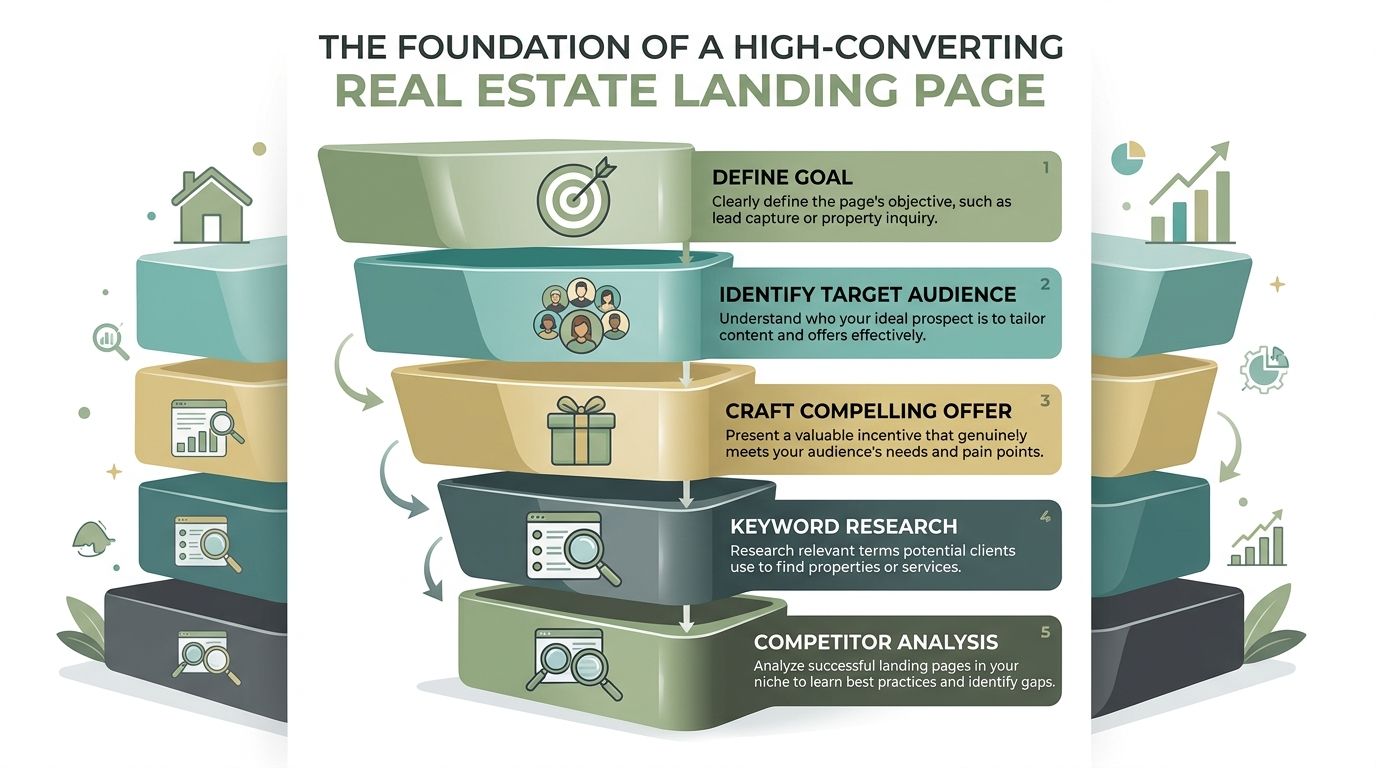
Start with one goal
Pick one action. Not three.
If your page asks visitors to book a call, browse listings, subscribe to your newsletter, and follow you on Instagram, you’ve already lost them. Every real estate landing page should have one primary outcome.
Good single-goal examples:
- Seller page: request a home value report
- Buyer page: download a neighborhood guide
- Relocation page: get a local area packet
- Listing page: schedule a private showing
When you define one goal, every other choice gets easier. The headline gets tighter. The form gets shorter. The CTA gets clearer.
Get specific about the audience
“Home buyers” is too broad. “Sellers” is still too broad.
You need to know who the page is for before you write a word. The more specific you get, the easier conversion becomes. A page for first-time buyers in one suburb will outperform a generic buyer page every time because the visitor immediately feels, “This is for me.”
Use filters like these:
- Location: city, ZIP code, subdivision, school district
- Stage: just browsing, comparing agents, ready to list, moving soon
- Need: valuation, downsizing, investment, relocation, luxury, first home
- Source: Instagram traffic, Google search, Facebook ad, email list
Practical rule: If the same page could work for everyone, it won’t persuade anyone.
Offer something worth the form fill
People don’t hand over their email because your branding looks polished. They do it because the offer solves a problem fast.
Your lead magnet has to match the audience’s immediate concern. Sellers want clarity. Buyers want guidance. Relocators want local knowledge. Investors want decision-making help.
Here are lead magnet ideas that work well for agents:
| Lead Magnet Type | Target Audience | Why It Works |
|---|---|---|
| Home valuation report | Potential sellers | Gives immediate relevance and taps into seller curiosity |
| Neighborhood guide | Relocating buyers | Helps buyers understand an area before they commit |
| First-time buyer checklist | New buyers | Reduces overwhelm and positions you as a helpful guide |
| Downsizing guide | Empty nesters or retirees | Speaks to a specific life transition |
| New listings alert signup | Active buyers | Offers ongoing value tied to current inventory |
| Seller prep checklist | Homeowners planning to list | Turns vague intent into a practical next step |
| Local market update | Owners and move-up sellers | Gives a reason to opt in without requiring a consultation |
If you need ideas, this roundup of lead magnets for real estate agents is a useful starting point.
There’s another reason to think in systems, not one-offs. Data shows that agents who expand from 10 to 15 landing pages see a 55% increase in leads, according to these 2026 landing page statistics from Involve.me. More targeted pages usually means more relevant offers, and more relevant offers usually means better conversion.
Don’t build one generic page and call it done. Build a small library of focused pages tied to actual client needs.
Crafting Compelling Copy That Converts Visitors
Most landing page copy fails because it talks like an agent instead of thinking like a prospect.
Visitors don’t care that you’re passionate, full-service, or committed to excellence. They care about their next decision. Your copy needs to meet that urgency in a few seconds, not a few scrolls.

Write the headline first
Your headline carries the page. If it’s vague, the rest of the page has to work too hard.
Strong headlines do three things. They name the outcome, call out the audience, and keep the wording simple. Don’t try to be clever. Clear wins.
Use formulas like these:
Discover What Your Home Could Sell for in [Area]
Get the [Neighborhood] Buyer Guide Before You Start Touring Homes
See New [City] Listings That Match Your Budget and Must-Haves
Thinking of Selling in [Area]? Start With a Local Price Snapshot
A weak headline says what the page is. A strong headline says why the visitor should care.
Use body copy that earns the click
After the headline, your subhead and bullets should answer one question fast: “What do I get if I fill this out?”
Keep it tight. Don’t write a mini blog post on the page. Use short sections and plain language.
A solid structure looks like this:
- Lead with the benefit: Tell them what they’ll receive.
- Add clarity: Explain how it helps them make a decision.
- Remove friction: Reassure them the process is quick and easy.
- Support the next step: Point them directly to the form or button.
Example body copy for a seller page:
Get a local home value estimate based on current market activity, not a generic national formula. You’ll see how nearby homes are positioning, what buyers are responding to, and what your next move could look like.
That works because it focuses on the prospect’s outcome, not your résumé.
Make the CTA direct
Your CTA button should finish the sentence the visitor is already thinking.
Bad CTA buttons are generic. “Submit” is weak. “Learn More” is lazy. “Contact Us” often feels too big of a commitment for a first click.
Use action-based CTA language:
- Get My Home Value
- Send Me the Guide
- Show Me New Listings
- Book My Consultation
- Get the Market Update
Your CTA should promise the result, not describe the action.
One more rule. Match the page copy to the traffic source. If your Instagram post promises a seller checklist, the landing page headline and button should deliver that exact checklist. If the message changes after the click, trust drops immediately.
Good landing page copy sounds like a helpful agent in a real conversation. Clear, specific, and focused on the client’s next move.
Designing a Clean and Trustworthy Page Layout
A page can have strong copy and still underperform if the layout creates friction.
Agents often overbuild landing pages because they borrow the structure of a full website. They add menu links, sidebars, extra sections, listing widgets, and too many design elements. That gives visitors more ways to leave than convert.
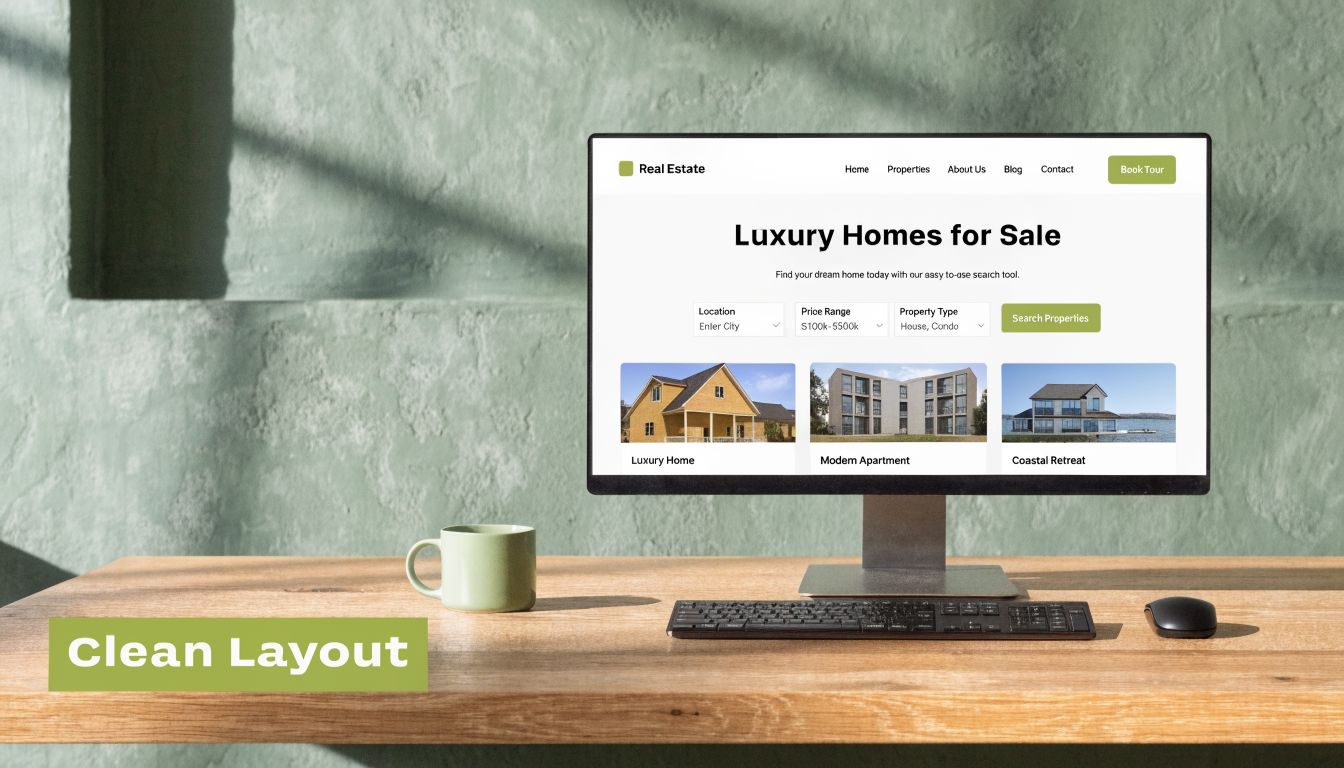
Build the page in the right order
The page should feel obvious to use. Not impressive. Obvious.
Start with a clean hero section. Put your headline, subhead, form or CTA, and one strong visual above the fold. That visual can be a local neighborhood image, a polished listing photo, or a professional brand photo if the offer is service-based.
Then move through the page in a simple sequence:
- Hero section with the main offer
- Short benefits section that explains what they get
- Trust section with testimonials, credentials, or market familiarity
- Form section if it isn’t already above the fold
- Simple footer with essential business details
Keep navigation minimal or remove it entirely. The whole point is to reduce exits.
If you want a faster start, using prebuilt landing page templates for real estate agents can help you avoid the usual layout mistakes.
Use trust signals without clutter
People hesitate before filling out a form. That’s normal. Your layout should lower that hesitation.
Strong trust elements include:
- Client testimonials: short, specific, believable
- Local expertise cues: neighborhood names, market familiarity, area focus
- Professional branding: consistent fonts, colors, and photography
- Reassurance near the form: simple language that explains what happens next
Don’t overdo it. One or two testimonials near the CTA work better than a giant wall of praise at the bottom of the page.
A short explainer video can also help if it supports the offer instead of distracting from it. This example shows the kind of visual walkthrough style many agents use on landing pages:
The form matters as much as the design around it. Ask only for what you need right now. If this is an early-stage lead magnet, name, email, and phone is usually plenty. If the form feels demanding, people bail.
A trustworthy layout doesn’t try to prove everything. It makes the next step feel safe and easy.
Finally, make your CTA button stand out visually. Use one accent color consistently. Don’t make visitors hunt for the button. If they have to search, you’ve added friction you didn’t need.
Launching and Promoting Your New Landing Page
A strong landing page with no traffic is just a draft sitting online.
Most agents don’t need a complicated launch plan. They need a consistent one. Start with the channels you already use, then add more targeted promotion once the page is live and working.
Start with channels you already own
Your easiest traffic usually comes from assets you control.
Put the landing page link in places like these:
- Instagram bio: especially if your current content supports the offer
- Instagram Stories: use the link sticker and a direct prompt
- Facebook posts: write one post about the problem and one about the solution
- Email signature: simple and easy, especially for active conversations
- Newsletter: feature the offer with a short intro and one clear button
- Google Business Profile posts: useful for local visibility
- Text follow-up: if someone asks a relevant question, send the page instead of writing the same explanation again
Don’t just “share the link.” Frame the value. Tell sellers what they’ll learn. Tell buyers what they’ll get. Lead with the offer, not the page itself.
Add search and paid traffic carefully
Organic search can send useful traffic over time if your page title, page description, and on-page copy match what people are searching for. Use location-specific language naturally. A seller page for one neighborhood should sound like it belongs to that neighborhood.
Paid traffic works best when the landing page and ad say the same thing. If your Facebook ad promotes a market update for one ZIP code, the page should repeat that message immediately. Same offer. Same audience. Same next step.
For Google Ads, keep the keyword intent close to the page. A valuation page should connect to seller-intent searches. A relocation guide should connect to relocation-intent searches. Don’t send all paid traffic to one generic real estate landing page and expect it to convert.
Promotion also needs repetition. Post the same offer more than once in different formats. One feed post, one Story sequence, one email mention, one short video, one testimonial post tied to the same page. Agents often quit after one share and assume the offer didn’t work. Usually, the problem is visibility, not the page.
How to Measure, Test, and Optimize for More Leads
Once the page is live, your job shifts from building to improving.
A lot of agents stop here because analytics feels technical. It doesn’t need to be. You don’t need a fancy reporting stack to know whether a landing page is doing its job. You need to watch a few meaningful signals and make small adjustments with discipline.
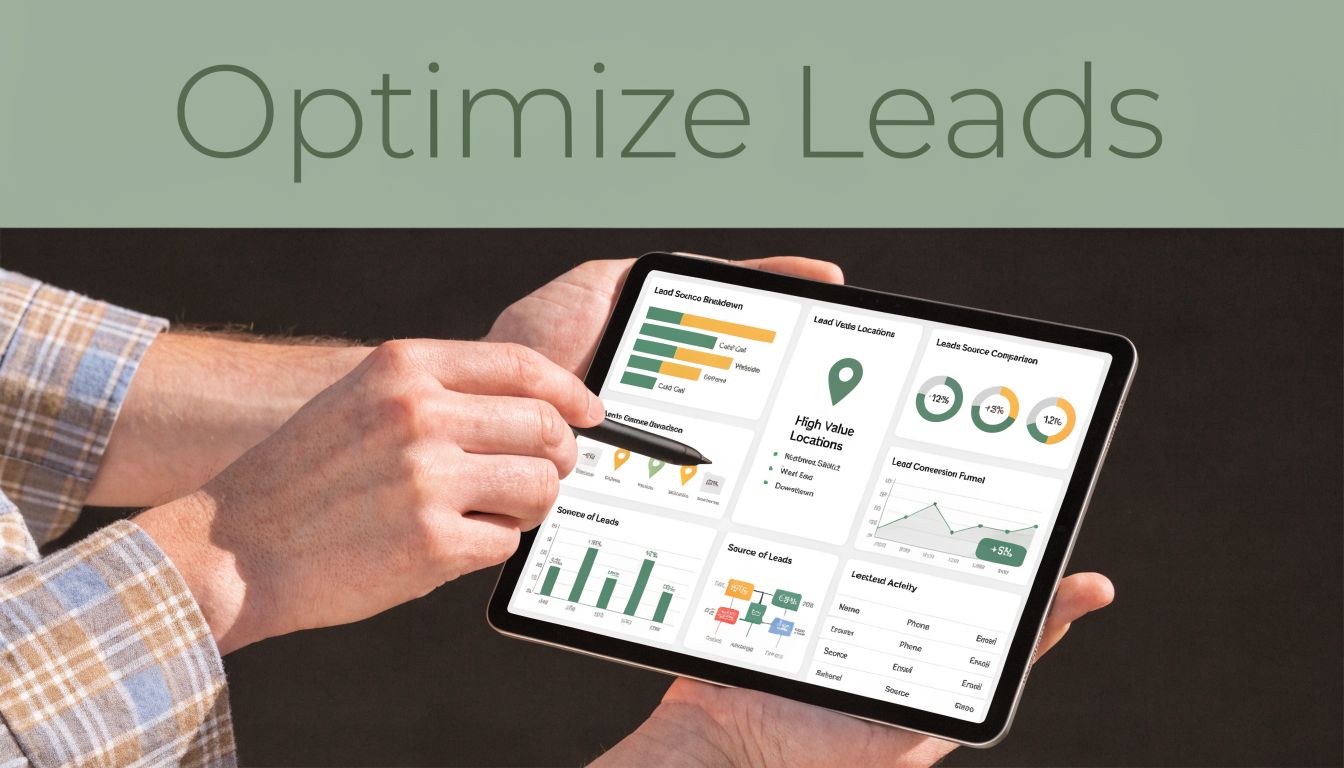
Track the numbers that matter
Start simple. Look at the traffic source, conversion rate, and form completions. That tells you where visitors came from, whether the page persuaded them, and how many actual leads you captured.
If you’re using Google Analytics and your page builder’s built-in reporting, that’s enough to begin. Don’t drown in dashboards.
Watch for patterns like these:
- Good traffic, weak conversions: the offer or page message is off
- Weak traffic, decent conversions: the page works, but not enough people are seeing it
- High mobile traffic, low mobile conversions: usability is likely the problem
- Form starts but few submissions: the form or CTA needs work
Test one variable at a time
A/B testing only works when you stay disciplined. Don’t change the headline, image, button color, form fields, and offer all at once. If everything changes, you learn nothing.
Test one thing, leave the rest alone, and give it enough traffic to show a pattern.
Strong things to test first:
- Headline angle: outcome-focused versus curiosity-focused
- CTA wording: “Get Free Valuation” versus “Schedule Viewing”
- Hero image: local lifestyle image versus property photo
- Form placement: above the fold versus lower on the page
- Offer framing: market update versus pricing guide
The useful part of testing isn’t the tool. It’s the habit. Agents who improve pages steadily usually outperform agents who rebuild pages constantly.
Small tests beat full redesigns. You’re looking for clearer buyer response, not prettier pages.
Fix mobile before anything else
A lot of real estate landing pages often fail here.
Mobile-first optimization is vital. Simple changes like using large, tappable buttons with a minimum size of 44x44px and 3-field forms can reduce lead friction by 40%, according to this mobile-first real estate landing page guidance from Beefree. That same guidance also recommends A/B testing CTAs such as “Get Free Valuation” versus “Schedule Viewing” to find what resonates with your audience.
Here’s the mobile checklist I’d use on every page:
- Check thumb usability: buttons should be easy to tap without zooming
- Trim the form: name, phone, and email is a strong default for many campaigns
- Scan the first screen: the offer and CTA should appear fast and clearly
- Review image weight: heavy visuals slow the page and kill intent
- Test on your own phone: don’t rely on desktop preview alone
If your page is hard to use on a phone, your traffic numbers won’t save you. Real prospects will leave before they ever read your value proposition.
Optimization isn’t glamorous. It wins anyway. The agents who treat their landing page like a live sales asset usually get more out of the same traffic than agents who publish once and move on.
Turn Your Landing Page into a Marketing System
One landing page can help you generate leads. A system of landing pages can support your pipeline all year.
That’s the shift most agents need to make. Stop thinking in isolated campaigns. Start thinking in repeatable monthly offers tied to the questions buyers and sellers already ask. One page for valuations. One for first-time buyers. One for relocation. One for a seasonal seller checklist. Then keep going.
The biggest challenge for agents is consistency. While most guides focus on one-off page design, they ignore the need for a repeatable system. A marketing membership provides this by delivering a complete, strategy-backed toolkit monthly, solving the problem of how to maintain lead flow without hiring a full-time marketer, as noted in this real estate landing page perspective from Leadpages.
That system gets stronger when your landing pages connect to your email strategy. If you want the follow-up side working too, this guide to email marketing for real estate fits naturally into the same process.
You don’t need more random marketing activity. You need a repeatable engine that gives each campaign a clear offer, a focused page, and a follow-up path.
If you want a simpler way to keep that system running, Restate Social gives real estate agents a monthly marketing membership with done-for-you campaign assets, including lead magnets and landing page support, so you can stay consistent without building everything from scratch. If you're ready to stop guessing and create a steadier lead flow, you can become a member here.